


|
War Exacts Emotional Toll
|
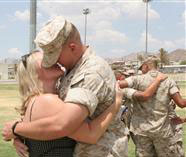 Why? In part because of the frequency of repeated lengthy deployments. The service member is absent from home for a year or more, then comes home and tries to make the transition from ever-vigilant, steely-eyed warrior conscious of every movement and sound, no matter how small, to warm, loving, gentle, relaxed husband and father (and/or son). That is a tough transition for many, if not most, and one that some are unable to make.
FORT CAMPBELL, Ky. (AP) — Far from the combat zones, the strains and separations of no-end-in-sight wars are taking an ever-growing toll on military families despite the armed services' earnest efforts to help. Divorce lawyers see it in the breakup of youthful marriages as long, multiple deployments in Iraq and Afghanistan fuel alienation and mistrust. Domestic violence experts see it in the scuffles that often precede a soldier's departure or sour a briefly joyous homecoming. Teresa Moss, a counselor at Fort Campbell's Lincoln Elementary School, hears it in the voices of deployed soldiers' children as they meet in groups to share accounts of nightmares, bedwetting and heartache. "They listen to each other. They hear that they aren't the only ones not able to sleep, having their teachers yell at them," Moss said. Even for Army spouses with solid marriages, the repeated separations are an ordeal. "Three deployments in, I still have days when I want to hide under the bed and cry," said Jessica Leonard, who is raising two small children and teaching a "family team building" class to other wives at Fort Campbell. Her husband, Capt. Lance Leonard, is in Iraq. Those classes are among numerous initiatives to support war-strained families. Yet military officials acknowledge that the vast needs outweigh available resources, and critics complain of persistent shortcomings — a dearth of updated data on domestic violence, short shrift for families of National Guard and Reserve members, inadequate support for spouses and children of wounded and traumatized soldiers. If the burden sounds heavier than what families bore in the longest wars of the 20th century — World War II and Vietnam — that's because it is, at least in some ways. What makes today's wars distinctive is the deployment pattern — two, three, sometimes four overseas stints of 12 or 15 months. In the past, that kind of schedule was virtually unheard of. "Its hard to go away, it's hard to come back, and go away and come back again," said Dr. David Benedek, a leading Army psychiatrist. "That is happening on a larger scale than in our previous military endeavors. They're just getting their feet wet with some sort of sense of normalcy, and then they have to go again." Almost in one breath, military officials praise the resiliency that enables most families to endure and acknowledge candidly that the wars expose them to unprecedented stresses and the risk of long-lasting scars. "There's nothing that has prepared many of our families for the length of these deployments," said Rene Robichaux, social work programs manager for the U.S. Army Medical Command. "It's hard to communicate to a family member how stressful the environment is, not just the risk of injury or death, but the austere circumstances, the climate, the living conditions." An array of studies by the Army and outside researchers say that marital strains, risk of child maltreatment and other problems harmful to families worsen as soldiers serve multiple combat tours. For example, a Pentagon-funded study last year concluded that children in some Army families were markedly more vulnerable to abuse and neglect by their mothers when their fathers were deployed in Iraq and Afghanistan. In Iraq, the latest survey by Army mental health experts showed that more than 15 percent of married soldiers deployed there were planning a divorce, with the rates for soldiers at the late stages of deployment triple those of recent arrivals. For the Army, especially, the challenges are staggering as it furnishes the bulk of combat forces. As of last year, more than 55 percent of its soldiers were married, a far higher rate than during the Vietnam war. The nearly 513,000 soldiers on active duty collectively had more than 493,000 children. Jessica Leonard at Fort Campbell says family support programs there have improved since her husband's first combat tour, helping her feel more self-reliant. Yet she's convinced that domestic violence and divorce are rising at the base, which is home to the 101st Airborne Division. "Infidelity is huge on both sides — a wife is lonely, she looks for attention and finds it easier to cheat," she said. "It does make even the most sound marriages second-guess." Among soldiers coming home, whether for two-week breaks that often end with wrenching good-byes or for longer stays, she sees evidence of lower morale and rising depression. "They come home, and find that problems are still there," she said. "Instead of a refreshing R-and-R, a nice little second honeymoon, it's battle for two weeks." There have been some horrific incidents shattering families of soldiers back from the wars — a former Army paratrooper from Michigan charged with raping and beating his infant daughter; a sergeant from Hawaii's Army National Guard accused of killing his 14-year-old son as the boy tried to save his pregnant mother from a knife attack by the soldier. In one of the saddest cases, a recently divorced airman who served with distinction in Iraq chased his ex-wife out of military housing with a pistol in February before killing his two young children and himself at Oklahoma's Tinker Air Force Base. Tech. Sgt. Dustin Thorson's former wife had sought a protection order against him, saying he threatened to kill the children if she filed for divorce. Officials at Tinker, while confirming that Thorson had been getting mental health care, would not say whether those problems related to his service in Iraq. His brother, Shane Thorson, a sheriff's deputy from Pasco, Wash., who also served in Iraq, has no doubt Dustin's war experiences contributed to the tragedy. "He didn't want to go — he was afraid, but he had a job that he'd signed up to do and he went and did it," Shane said. "I do think it led up to everything that happened. ... It opened up a world of death and chaos and uncertainty." Shane, who is married and has an 8-year-old daughter, is sure the deployments have damaged many marriages. "My wife and friends, they tell me I'm not the same person before I came back — not as loving," he said. "You really realize how insignificant you are in this world, and life moves on whether you're there or not." Overall, the Army says its domestic violence rates are no worse than for civilian families. However, critics say there is a lack of comprehensive, updated data that reflects the impact of war-zone deployments and tracks cases involving veterans, reservists and National Guard members. The Miles Foundation, which provides domestic-violence assistance to military wives, says its caseload has more than quadrupled during the Iraq and Afghan conflicts. "The tactics learned as part of military training are often used by those who commit domestic violence," said the foundation's executive director, Christine Hansen, citing increased proficiency with weapons and psychological tactics such as sleep deprivation. Jackie Campbell is a nursing professor at Johns Hopkins who served on a Defense Department task force examining domestic violence. She says the military's data on the problem is based only on officially reported incidents, and should be supplemented with confidential surveys such as some that were conducted before the Iraq war. "They have no clue what the rate of domestic violence is — they only know what's reported to the system, and that's always lower than the actual rate," Campbell said. "I'm disappointed.... I know the system is stressed to the umpteenth degree. But I do think they need to do the right kind of research so they can keep up with this." One complication, she said, is the high rate of post-traumatic stress disorder among service members returning from war. She said PTSD raises the risk of domestic violence, yet many soldiers and their spouses don't want to acknowledge PTSD or any domestic crises for fear of derailing the soldier's career. "They know the power of the military will come down on them," Campbell said. "The women are often reluctant to have that happen." At Fort Campbell, Family Advocacy Program director Louie Sumner — who's in charge of combating domestic violence — has encouraged people to report suspected abuse, to the point where many allegations turn out to be unsubstantiated. But Sumner said his program, though considered one of the Army's best, should do more outreach with the majority of families who live off the huge base, in subdivisions, apartments and trailer parks where many couples' troubles may go undetected. Sumner is sure that the repeated deployments heighten the risk of family violence. "When the soldier goes overseas three, four times, the fuse is a lot shorter," he said. "They explode quicker, and the victim gets hurt worse." He marveled that some of the hasty marriages by youthful soldiers survive the rigors of deployment. "My wife and I have been married 38 years," he said. "I'm not sure we could have stood being apart 30 of the next 42 months at the start of our marriage. That's a long time when you're real young." The independence that wives develop at home alone leads to friction when a returning husband seeks to restore the old order in household decision-making. "Somebody who's violent and controlling of his partner before he leaves will spend a lot of time while he's away wondering what she's doing, worrying that he doesn't have that day-to-day control," said Debbie Tucker, who co-chaired the Pentagon's domestic violence task force. "He comes back with the attitude that it needs to be re-established as firmly as possible." Despite the stresses, a study published in April by Rand Corp. concluded that divorce rate among military families between 2001 and 2005 was no higher than during peacetime a decade earlier. But the study doesn't reflect the third and fourth war zone deployments that have strained many military marriages over the past three years. Maj. Mike Oeschger gets a closer look at struggling marriages than he'd like in his role as rear detachment commander for the 1st Brigade Combat Team at Fort Campbell. Dealing with family crises while the brigade is in Iraq is a critical part of his job. "The biggest problems usually revolve around money — the husband may not have given the wife access to funds," he said. Oeschger, a husband and father who served in Iraq himself, has seen infidelity in multiple forms. Some wives at the base are preyed on by men who know the husbands are overseas; some war-zone soldiers pursue extramarital affairs over the Internet. "Often the guy comes back, tells his wife, 'I'm not interested in you any more. I think we're done,'" Oeschger said. He'd rather stay out of his soldiers' personal lives, but that's not always an option. "There's almost nothing that's private in the Army," he said. "Once it starts to affect performance, I'm involved and want to know every detail. It's miserable stuff ... but it's my job." Col. Ronald Crews, one of several chaplains called from the reserves to help with family counseling, said long-distance marital crises became so severe for two Fort Campbell soldiers recently that they were sent home from Iraq to handle them. "Their commander said they wouldn't be of any use until the problems were resolved," Crews said. The soldiers were required to meet with him weekly. One returned to Iraq and the other did not. For some time, chaplains have been conducting marriage workshops for soldiers back from deployment. Now, says Crews, married soldiers also are being required to attend such workshops before they leave. "Deployments don't help in strengthening a marriage, but they do not have to kill marriages," Crews said. "That's a choice a couple has to make." Medical personnel, meanwhile, have been directed to be more aggressive in screening spouses of deployed soldiers for depression. More than 1,000 "family readiness support assistants" are being added, as are dozens of marriage and family therapists. A respite child care program is expanding to provide more relief to stressed mothers. However, for families living off-base, there are often far fewer support programs readily available. Advocacy groups also say more must be done for families of wounded and traumatized soldiers who leave the service. At a recent congressional hearing, Barbara Cohoon of the National Military Families Association suggested the Veterans Administration is not meeting these needs, and said the anguish of wounded soldiers' children "is often overlooked and underestimated." Stacy Bannerman, an anti-war activist whose husband served with the Washington State National Guard in Iraq, says many Guard members and reservists don't get adequate treatment when — like her husband — they are diagnosed with PTSD. "The families are scattered everywhere, and we don't have the support networks that active duty does," Bannerman said. "There's very little attention paid to reintegration — bammo, you suddenly go back to your civilian life. I haven't spoken to anyone who hasn't experienced some degree of stress on a marriage." Her own marriage nearly became one of the casualties. She and her husband, Lorin, were separated for more than a year, but now — after finding a counselor outside the military — are working at reconciliation even as Lorin faces a second deployment to Iraq in August. "It's been a long, arduous process," said Bannerman, who has moved to Oregon to work at an animal sanctuary which is seeking to involve traumatized veterans in its programs. Many returning soldiers experience some form of depression, lapsing into substance abuse, sleeping fitfully, withdrawing from family activities. Children may feel their father is too distant, or unsettlingly changed. "The kids may not really recognize their parent," said Col. Elspeth Ritchie, psychiatry consultant to the Army surgeon general. "Their expectations build up, and then expectations aren't met." The Army would like to beef up psychiatric care for children, Ritchie said, but is hampered by a national shortage of child psychiatrists. "The children of these families are suffering damage emotionally and a lot of them aren't getting any help," said Lee Rosen, whose North Carolina law firm handles many military divorces. "We're going to have fallout from this for a long time." Rosen says the breaking point for many couples often arrives with a second or third deployment. "To go off for one deployment for a year is difficult, but when that soldier comes back, people are able to adjust, to heal," he said. "When you go a second time, and are threatened with the possibility of a third, it's just devastating." Yet many marriages don't survive even a first deployment. While 1st Lt. Mike Robison was serving in Iraq in 2003-04, his wife, Candance, depicted him as a "good, brave man" in a letter she wrote to President Bush. But the marriage fell apart after Robison's return home to Texas. Candance said they argued over her role managing the household and how he treated her 10-year daughter from a previous relationship. "It absolutely changed him," Candance said of his deployment. "I still struggle every day — that year has affected every single aspect of my life." Andrew Brown, an Army Reserve sergeant from Pennsylvania, says his marriage failed to survive the effects of his Iraq deployment in 2004-05. Returning home, he was diagnosed with PTSD and deduced that his wife, lonely in his absence, had been having an affair. "With the mental state I was in, I was relying on her to provide support, and she wasn't ready to do that," Brown said. "What I went through is not an isolated incident," he added. "Guys came back — they'd shut down, turn to the bottle, have lots of fights with their spouses." At their small ranch house near Fort Campbell, Staff Sgt. Brian Powell and his wife, Krystal, expressed determination to keep their marriage on track as they raise two young sons and as Brian faces a second deployment — this time to Afghanistan — starting in December. Brian was in Iraq when his eldest son, Jamison, was born in 2006. He got home on a brief leave three days after the birth. "It was just two weeks," Brian said. "You don't want to get attached because you know you have to go back." "It's a really hard transition, coming back from blood, death, corruption to a wife and baby. You feel you don't know each other," Krystal added. "But if you have faith, you get through it." |


 Site best viewed with Firefox
New! Comments
Join our conversation! Leave me a comment about this page in the box below. If your comment is about another page on this site, please leave your comment on that page, because I have no ability to move it to the correct page. Thanks!